
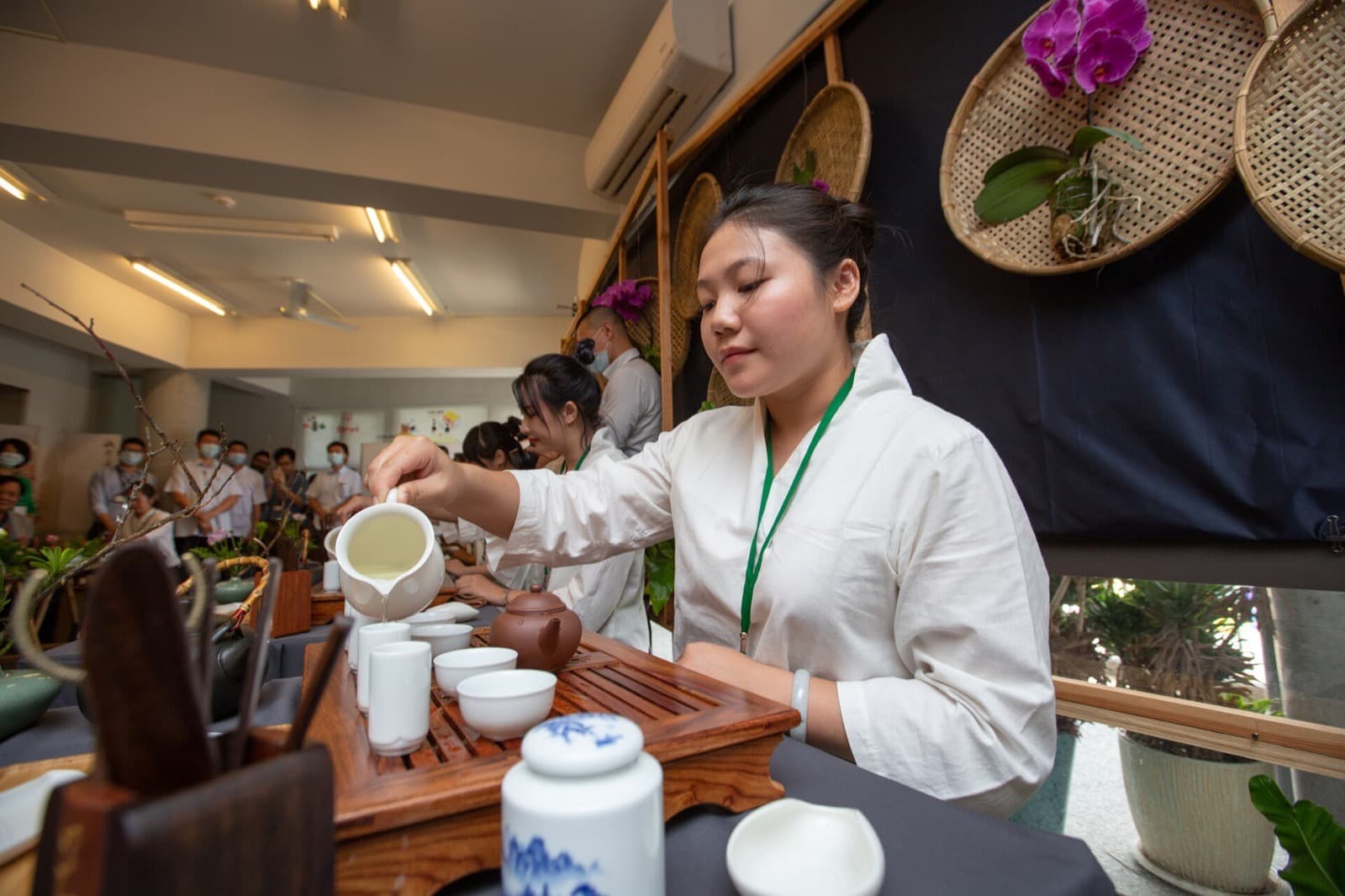
A small clay pot, a tray beaded with water, the quiet clink of tiny cups, and steam curling up from a leaf that has been steeped a dozen times — this is the Chinese tea ceremony in its most familiar form. It is less a rigid performance than a way of paying attention.
Most people picture something formal and unreachable. In reality, the everyday Chinese tea ceremony — known as gongfu cha — is something a tea lover does at their own table on an ordinary afternoon. "Gongfu" (or kung fu) here doesn't mean martial arts; it means skill acquired through patient practice. Applied to tea, it means brewing with enough care to draw out everything the leaves have to give.
This guide explains where the ritual comes from, the teaware involved, and a simple step-by-step you can follow at home tonight.
What 'gongfu cha' actually means
Gongfu cha (功夫茶) translates loosely as "making tea with skill" or "tea brewed with effort and attention." The style is most associated with the Chaoshan region of Guangdong and with Fujian, and it spread through the tea-growing south of China before becoming the standard way serious drinkers brew oolong and pu-erh worldwide.
The core idea is simple but transformative: use a lot of leaf in a small vessel and brew a rapid series of short infusions, rather than a little leaf in a big cup steeped once for a long time. A gongfu session might yield eight or ten cups from a single measure of leaf, each infusion revealing a slightly different facet — the bright top notes first, then the body, then the sweet, lingering finish.
Unlike the highly codified Japanese tea ceremony (chanoyu), gongfu cha is relatively relaxed. There's a right way to do things, but the emphasis is on the tea and the company, not on choreography. It pairs naturally with the six types of Chinese tea.
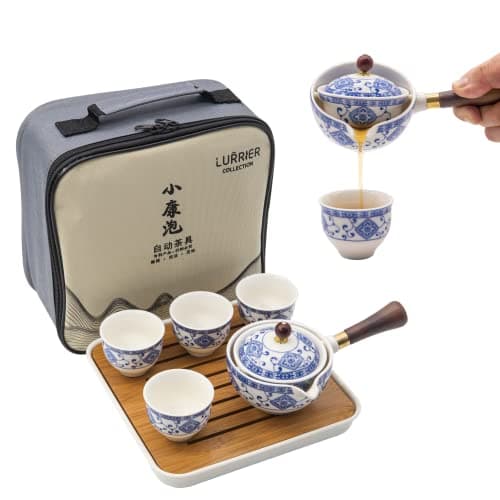
LURRIER Porcelain Chinese Gongfu Tea Set,Portable Teapot Set
A top-rated pick our readers reach for.
Shop Now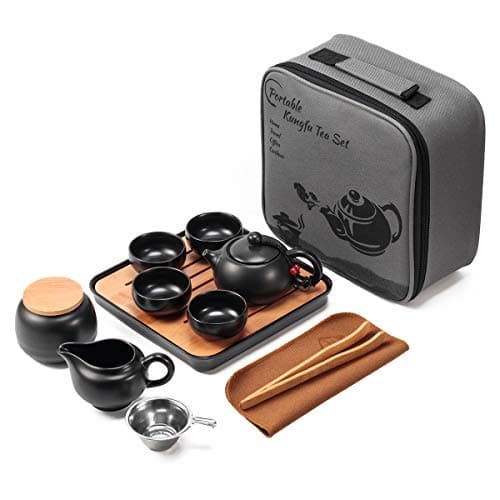
Chinese Tea Pot Cup Set with Tray Infuser - Travel Ceramic Tea
A top-rated pick our readers reach for.
Shop Now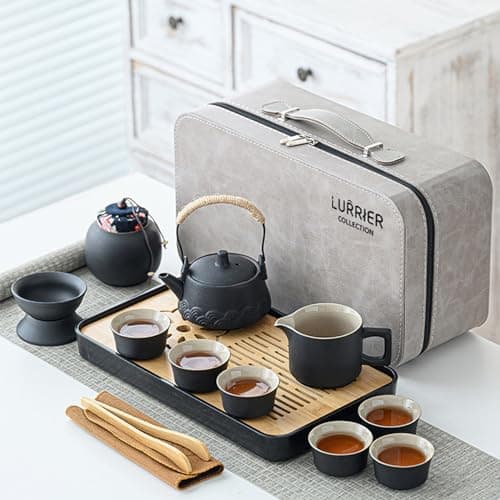
LURRIER Gongfu tea sets, Portable Ceramic TeaSet, Asian Tea
A top-rated pick our readers reach for.
Shop NowProduct prices and availability are accurate as of September 14, 2026 and are subject to change. Any price and availability information displayed on Amazon at the time of purchase will apply.
A brief history of tea ritual in China
Tea has been part of Chinese life for well over a thousand years. During the Tang dynasty, the scholar Lu Yu wrote the Cha Jing ("The Classic of Tea"), the first known monograph on tea, laying out cultivation, tools, and brewing as a refined pursuit. In the Song dynasty, whisked powdered tea and elaborate tea competitions were fashionable at court.
The gongfu style we recognize today crystallized later, especially around the small-pot Yixing-clay brewing of the Ming and Qing eras, once loose-leaf tea replaced pressed tea cakes as the everyday format. The Chaoshan people refined it into a social art — a pot of strong oolong shared among friends in thimble-sized cups.
Today the ritual carries cultural weight beyond the cup. Serving tea is a gesture of respect and hospitality; at traditional weddings, the couple serves tea to their elders as a mark of gratitude. Understanding that context is part of understanding the Chinese tea ceremony.
The teaware you'll see (and what each piece does)
Part of what makes the ceremony absorbing is the collection of small, purpose-built tools. You don't need all of it to start — a gaiwan, a pitcher, and a couple of cups will do — but here's the full cast.
- Gaiwan — a lidded brewing bowl; the most versatile vessel, good for any tea. See our gaiwan guide.
- Yixing teapot — small unglazed clay pot that seasons over time; traditionally dedicated to one type of tea.
- Cha hai (pitcher / 'fairness cup') — you decant the finished infusion into this so every cup is equal strength.
- Cups — small, so you can taste each infusion at its peak and refill often.
- Tea tray (cha pan) — a slotted or draining tray that catches spills and rinse water.
- Tea tools — tongs, a scoop, a needle for clearing the spout.
- Cha he — a small dish for presenting and appreciating the dry leaf before brewing.
A complete beginner set is inexpensive and widely available; our Chinese tea set guide walks through what to look for.
How to perform a simple gongfu cha at home
You can do a satisfying home version with a gaiwan, a pitcher, two cups, and a kettle. Here's a beginner-friendly sequence.
- Warm the ware. Pour hot water into the gaiwan, pitcher, and cups, then discard it. This preheats everything and rinses off dust.
- Add the leaf. Use roughly 5–6 g of tea per 100 ml of gaiwan — far more than you'd use in a mug. Appreciate the dry leaf's aroma first.
- Rinse (for oolong and pu-erh). Pour hot water over the leaves and immediately pour it off. This 'awakens' rolled or aged leaves. Skip for green tea.
- First infusion. Fill the gaiwan, cover, and steep just 15–30 seconds. Match the water temperature to the tea (cooler for green, near-boiling for oolong, black, and pu-erh).
- Decant completely. Pour all the liquid into the pitcher — leaving none behind prevents the next steep from turning bitter — then share it into the cups.
- Sip and repeat. Drink, notice how it tastes, and re-infuse. Add a few seconds to each successive steep. Keep going until the flavor fades, often 6–10 rounds for good oolong or pu-erh.
The pace is the point. There's no rush, and every infusion is a small reset.
A note on water: use fresh, filtered water and don't let it sit at a hard boil for ages, which flattens the taste. Match temperature to the tea — cooler (around 180°F) for green, near-boiling for oolong, black, and pu-erh. And keep your movements unhurried; part of gongfu cha's charm is that it slows your hands and, with them, your mind.
Which teas suit the ceremony best
Gongfu brewing rewards teas with layers to reveal over many infusions, so it shines with:
- Oolong — Tieguanyin and rock oolongs like Da Hong Pao are the classic gongfu teas, opening up gradually across steeps. See Chinese oolong tea.
- Pu-erh — both raw (sheng) and ripe (shou) are built for multiple infusions; a good aged sheng can go a dozen rounds. See pu-erh tea.
- Chinese black tea — Dianhong and Keemun brew beautifully gongfu-style, sweet and malty. See Chinese black tea.
Green and white teas can be brewed gongfu too, just with cooler water and gentler timing. The method isn't reserved for expensive tea — it makes even a modest leaf taste clearer and more interesting.
Common mistakes beginners make
A few easy fixes separate a muddy session from a bright one.
Too little leaf. Gongfu brewing depends on a high leaf-to-water ratio. If your cups taste thin and watery, add more tea, not more time.
Leaving liquid in the gaiwan between steeps keeps the leaves stewing and turns later infusions bitter — always decant fully. Boiling water on green tea scorches it; use cooler water for delicate types. And rushing defeats the purpose — the ceremony is meant to slow you down, not become another task to optimize. If your first attempts feel clumsy, that's normal; the 'gongfu' really does come with practice.
One more subtle mistake: fussing over 'doing it right' instead of tasting. The whole point of brewing this way is to notice how the tea changes cup to cup — bright to sweet to soft. If you spend the session worrying about hand positions, you'll miss the very thing the method exists to reveal. Pour, sip, pay attention, adjust. That feedback loop, repeated over a few sessions, teaches you more than any set of rules.
The ceremony as a moment of calm
Beyond technique, many people are drawn to the Chinese tea ceremony for the same reason they're drawn to any small ritual: it creates a pocket of stillness. Measuring the leaf, warming the cups, watching the color deepen — these tiny, repeatable actions give the mind somewhere gentle to rest.
You don't have to frame it as meditation to feel the effect, though the two overlap; if that appeals, see our note on tea meditation and building a daily tea ritual. At Tea & Peace, this is really the heart of the whole site: tea as a reliable, ordinary way to make an afternoon feel a little more spacious. The gongfu tray is one of the loveliest containers for that — a few unhurried minutes, entirely yours.
From our testing notes
If you want to feel the difference the ceremony makes without buying anything special, run this test with any oolong you have: brew one cup in a mug (boiling water, three minutes) and, separately, do three quick 20-second gaiwan steeps. Line up the gaiwan cups and taste them in order. Most people are surprised that infusion two or three is sweeter and more aromatic than the mug — proof that the ritual isn't just aesthetic; short repeated steeps genuinely extract tea more gracefully.
Sources & further reading
Frequently asked questions
What is the Chinese tea ceremony called?
The everyday practice of brewing tea with skill and care is called gongfu cha (功夫茶), sometimes written kung fu cha. 'Gongfu' means skill developed through practice, not martial arts. It refers to brewing with a small vessel, lots of leaf, and many short infusions.
Is gongfu cha the same as the Japanese tea ceremony?
No. The Japanese tea ceremony (chanoyu) centers on whisked matcha and is highly formalized. Chinese gongfu cha uses loose-leaf tea steeped many times and is more relaxed, focused on getting the best flavor from the leaves rather than on strict choreography.
What do I need to start a Chinese tea ceremony at home?
At minimum: a gaiwan or small teapot, a pitcher ('fairness cup') to equalize the brew, a couple of small cups, and a kettle. A draining tray is helpful for spills. Inexpensive beginner sets include these; see our Chinese tea set guide.
Why are the cups so small?
Small cups let you taste each of the many short infusions at its peak, while it's still hot and aromatic, and they encourage frequent refilling and sharing. Because gongfu brewing produces strong, concentrated tea, a small serving is also more balanced than a full mug.
How much tea should I use for gongfu brewing?
A common guideline is about 5–6 grams of leaf per 100 ml of vessel — much more than Western-style brewing. The high ratio is what allows very short steeps and many successive infusions.
How many times can I re-steep the leaves?
It depends on the tea, but good oolong and pu-erh commonly give 6–10 or more infusions gongfu-style, each slightly different. You stop when the flavor and aroma finally fade to water.
Do I need an expensive Yixing pot?
No. A simple porcelain gaiwan is versatile, affordable, and arguably the best all-round vessel for beginners because it doesn't retain flavor and works for every tea type. Yixing clay pots are wonderful but are traditionally dedicated to a single tea type and take time to season.
What's the significance of serving tea in Chinese culture?
Serving tea is a gesture of respect, gratitude, and hospitality. In a traditional Chinese wedding, the couple serves tea to their elders as a formal sign of honor. Offering tea to a guest is one of the oldest expressions of welcome in Chinese life.
Do I need to learn Chinese to follow a tea ceremony?
Not at all. A handful of terms turn up often enough to be worth recognizing — gaiwan (the lidded bowl), gongdao bei (the sharing pitcher), hui gan (the returning sweetness after a swallow) — but the practice itself is physical, not verbal. You learn it by pouring, not by vocabulary. If you visit a Chinese tea house, the two-finger table tap to say thank you for a pour will carry you further than any phrase.