
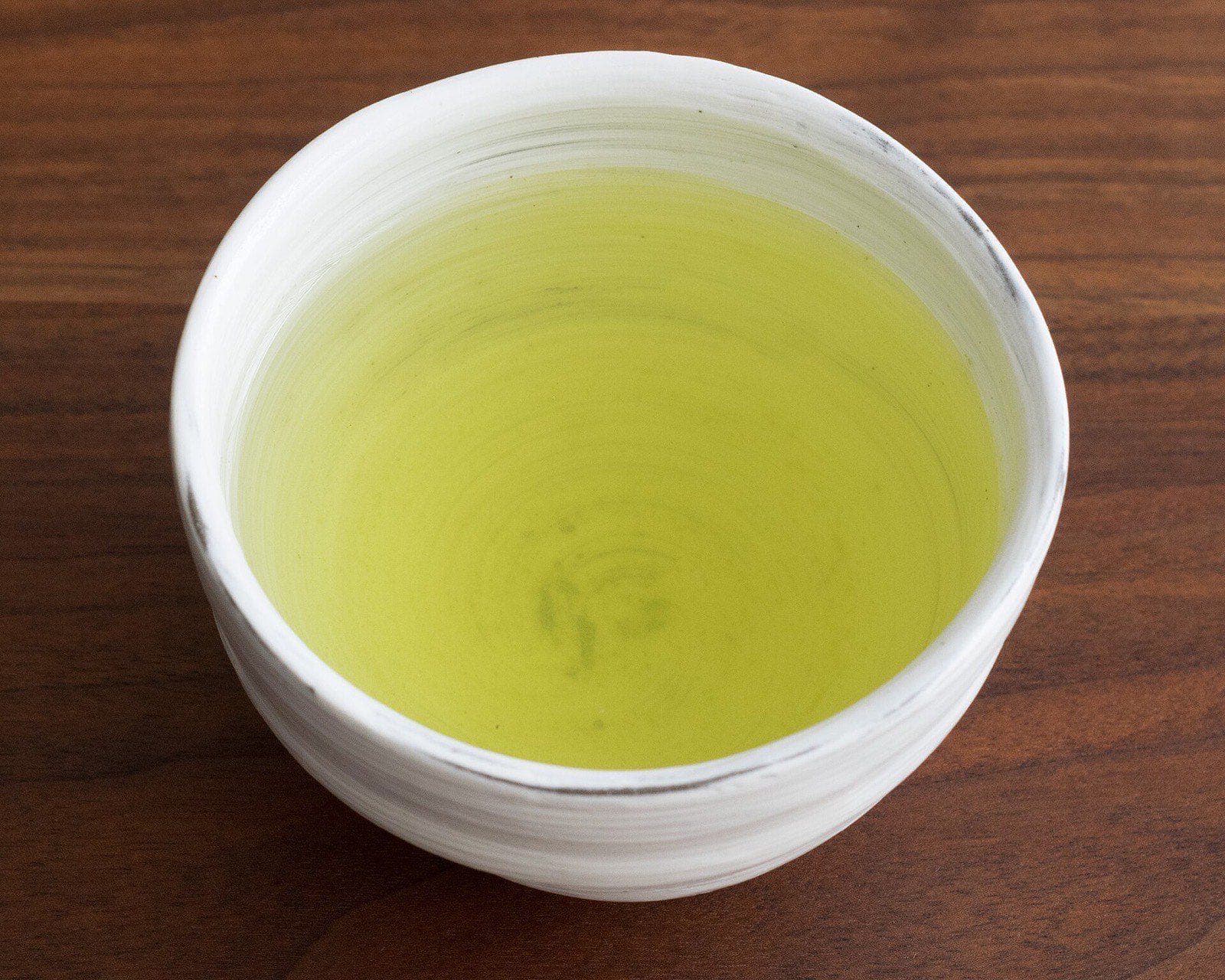
The first sip of a well-brewed Chinese green tea is a small revelation: sweet, faintly nutty, with a fresh green aroma somewhere between steamed chestnut and just-cut grass — and not a trace of the bitterness so many people assume green tea has to have. That bitterness is almost always a brewing problem, not a flavor of the tea itself.
China is the birthplace of green tea and still produces the overwhelming majority of it, in hundreds of regional styles. This guide focuses on the ones worth knowing first — Longjing (Dragonwell), Gunpowder, and Bi Luo Chun — what they taste like, where they come from, and exactly how to brew them so they taste the way the farmer intended.
Quick answer
- ✓Chinese green tea is unoxidized — the leaves are pan-fired or steamed right after picking to keep them fresh and green.
- ✓Longjing (Dragonwell) is the most famous, prized for flat leaves and a sweet, chestnut-like flavor.
- ✓The #1 rule: brew with cooler water (175–185°F), not boiling, to avoid bitterness.
- ✓Most Chinese greens can be re-steeped two or three times.
What makes a tea 'Chinese green tea'
Green tea is defined by what doesn't happen to it: oxidation. Right after the leaves are plucked, they're heated — most Chinese greens are pan-fired in a wok, while Japanese greens are usually steamed — to deactivate the enzymes that would otherwise turn the leaf dark. This step, called sha qing ("kill green"), locks in the fresh, vegetal character and the green color.
Because the leaf is minimally processed, green tea tastes closest to the living plant of any of the six types of Chinese tea. The pan-firing typical of Chinese greens tends to give them a toastier, nuttier, more chestnut-like profile, versus the grassier, more marine notes of steamed Japanese greens. Both are lovely; they're just different traditions from the same plant.
Tea & gear for this guide
Hand-matched Amazon picks with strong owner ratings. As an Amazon Associate, Tea & Peace earns from qualifying purchases.
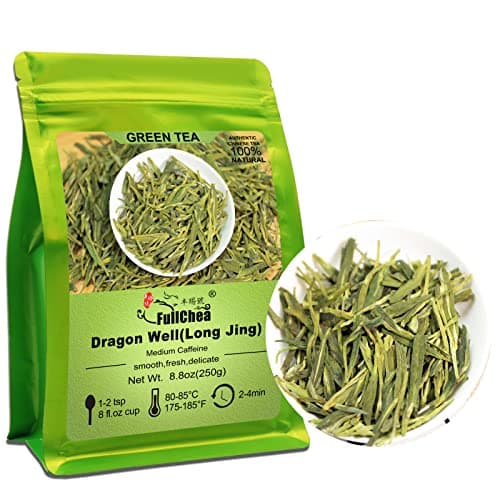
FullChea - Longjing Tea - Dragonwell Tea - Chinese Green Tea Loose Leaf
Pan-fired Chinese green tea (Longjing style) — 4.3★ across 643 ratings.
Shop Now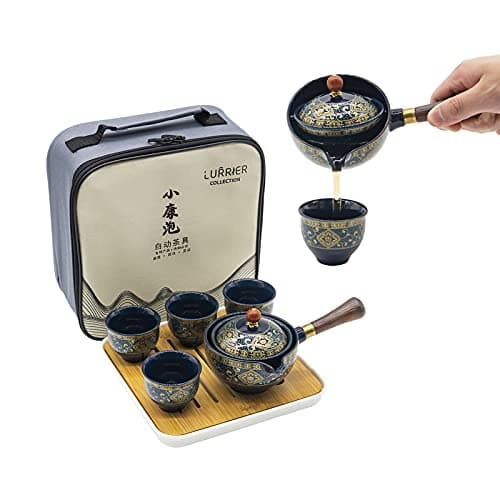
LURRIER Porcelain Chinese Gongfu Tea Set,Portable Teapot Set with 360
Gongfu tea set for traditional Chinese brewing — 4.6★ across 1,436 ratings.
Shop Now![ChaWuWarmSun [B] Longjing Dragon Well Green Tea Loose Leaf, 3.5oz/100g](/_next/image?url=https%3A%2F%2Fm.media-amazon.com%2Fimages%2FI%2F41MGeETEWUL._SL500_.jpg&w=640&q=75&dpl=dpl_3mWQXSUux5i73qaPL8F5UHoXJhfC)
ChaWuWarmSun [B] Longjing Dragon Well Green Tea Loose Leaf, 3.5oz/100g
Pan-fired Chinese green tea (Longjing style) — 4.3★ across 358 ratings.
Shop NowProduct prices and availability are accurate as of September 14, 2026 and are subject to change. Any price and availability information displayed on Amazon at the time of purchase will apply.
The famous Chinese green teas, compared
Here are the classics you'll see most often, with what to expect from each.
| Tea | Region | Leaf appearance | Flavor notes |
|---|---|---|---|
| Longjing (Dragonwell) | Hangzhou, Zhejiang | Flat, smooth, spear-shaped | Sweet, chestnut, mellow, buttery |
| Bi Luo Chun | Dongting, Jiangsu | Tightly curled, downy | Fruity, floral, delicate, fragrant |
| Gunpowder (Zhu Cha) | Zhejiang | Rolled into tight pellets | Bold, slightly smoky, robust |
| Huangshan Maofeng | Anhui | Slightly curved, tippy | Fresh, orchid-like, smooth |
| Taiping Houkui | Anhui | Long, flat, pressed | Orchid aroma, mild, elegant |
| Mao Jian | Xinyang, Henan | Thin, needle-like | Brisk, fresh, slightly astringent |
Longjing is the benchmark — if you try one Chinese green tea, make it a real West Lake Dragonwell. Bi Luo Chun rewards those who like fragrance and delicacy. Gunpowder is the workhorse: robust, affordable, long-lasting in storage, and the base for Moroccan mint tea.
Dragonwell (Longjing): the one to know
Longjing, or Dragonwell, is China's most celebrated green tea, grown in the hills around West Lake in Hangzhou. Authentic West Lake Longjing is protected by origin and can be expensive; much of what's sold simply as "Dragonwell" is grown elsewhere in Zhejiang to the same style and is perfectly enjoyable.
You can recognize good Longjing by its flat, glossy, jade-to-yellow-green leaves, pressed smooth during pan-firing. The aroma is toasty and sweet; the taste is round and mellow with almost no bitterness and a lingering sweet finish the Chinese call hui gan. It's a spring tea — the earliest "pre-Qingming" pickings (before early April) are the most prized. Brew it gently and it will give you two or three fragrant infusions.
Bi Luo Chun and Gunpowder: two more to know
Two other Chinese greens deserve a proper introduction, because they sit at opposite ends of the delicacy scale.
Bi Luo Chun ("Green Snail Spring") comes from the Dongting area of Jiangsu and is one of China's most fragrant teas. The tiny leaves are picked young and covered in fine white down (bai hao), then rolled into delicate snail-like curls. In the cup it's floral, fruity, and remarkably aromatic — some say you can smell it across the room. It's a tea to brew gently and savor slowly; the best grades are picked very early in spring.
Gunpowder (zhu cha) is Bi Luo Chun's rugged opposite: leaves rolled into hard little pellets that look like shot, which unfurl as they steep. The rolling protects the tea from air, so Gunpowder keeps its flavor longer than most greens and travels well. It brews bold, slightly smoky, and robust — strong enough to stand up to mint and sugar, which is why it's the traditional base of Moroccan mint tea. If you find delicate greens too subtle, Gunpowder is the green tea with backbone.
Yellow tea: green tea's rare cousin
While we're on fresh, lightly-processed Chinese teas, it's worth a nod to yellow tea (huang cha), one of the rarest of the six types and closely related to green. It's made almost like green tea, but with an extra slow, gentle "sealed yellowing" step (men huang) that mellows the grassy edge into something rounder and sweeter.
The most famous example is Junshan Yinzhen, a prized bud tea from Hunan. Yellow tea is produced in tiny quantities and can be hard to find outside China, but if you enjoy the fresh character of green tea with a little less briskness, it's a lovely thing to seek out. Brew it like a green — cooler water, short steeps — and treat it as a special-occasion cup rather than an everyday one. It's a small reminder that Chinese tea's six categories have fascinating corners well beyond the famous names.
How to brew Chinese green tea without bitterness
Bitterness in green tea almost always comes from water that's too hot or steeping that's too long. Fix those two things and green tea becomes sweet and smooth. Here's a reliable method:
- Heat water to 175–185°F (80–85°C). If you don't have a variable kettle, boil then let it sit 1–2 minutes.
- Use about 1 teaspoon (2–3 g) per 8 oz of water, or more if brewing gongfu-style in a small vessel.
- Steep briefly — 1 to 2 minutes for the first Western-style infusion, or 20–40 seconds gongfu-style.
- Re-steep. Add water again for a second and third infusion, extending the time slightly each round.
A traditional and beautiful method is to brew loose Longjing directly in a tall glass with no strainer, watching the leaves "dance" and sink. For a deeper walkthrough that applies to any green, see how to brew green tea.
Buying and storing green tea well
Green tea is the most perishable of the six types because its fresh character fades with time, light, heat, and air. A few habits keep it tasting alive:
- Buy fresh and buy small. Look for a recent harvest year; spring-picked greens are best. Don't stockpile more than you'll drink in a few months.
- Store airtight, cool, and dark. An opaque tin away from the stove and spices is ideal. Green tea readily absorbs odors.
- Skip the fridge unless sealed. Some vendors cold-store green tea, but at home, condensation and food smells do more harm than good unless it's tightly sealed.
Good green tea should smell fresh and vegetal, not flat or hay-like (that staleness signals age). Whole, intact leaves generally mean better quality than dust and fragments — one more reason to choose loose leaf tea.
A note on green tea and everyday life
Green tea has a long association with wellbeing in Chinese culture, and it's widely enjoyed as a light, refreshing daily drink. It contains caffeine (less than black tea, generally) along with the amino acid L-theanine, which many drinkers feel gives green tea's lift a calmer, steadier quality than coffee.
That said, tea is a beverage, not a treatment. It's a pleasant part of a balanced routine, not medicine — if you have specific health questions, a doctor or dietitian is the right source, not a tea blog. Enjoyed for what it is, a cup of good Chinese green tea is simply one of the nicest, lowest-effort pleasures around. If you like it iced, it also makes a wonderful cold brew green tea — cool water extracts it slowly and sweetly, with almost no bitterness at all.
From our testing notes
A quick brewing comparison worth doing at home: steep the same Longjing twice, once with boiling water for three minutes and once at about 180°F for 90 seconds. The boiling-water cup comes out yellow, sharp, and astringent; the cooler cup is pale green, sweet, and nutty with a lingering sweetness. It's the clearest demonstration that green tea's reputation for bitterness is really about brewing temperature, not the leaf.
Sources & further reading
Frequently asked questions
What is the most popular Chinese green tea?
Longjing, also called Dragonwell, from the West Lake area of Hangzhou. It's prized for its flat, smooth leaves and a sweet, chestnut-like flavor with almost no bitterness, and it's widely considered China's most famous green tea.
Why does my Chinese green tea taste bitter?
Almost always because the water was too hot or you steeped too long. Green tea wants water around 175–185°F (80–85°C) and a short steep of 1–2 minutes. Using boiling water is the single most common cause of bitter green tea.
What's the difference between Chinese and Japanese green tea?
Chinese green teas are usually pan-fired, giving toasty, nutty, chestnut-like notes, while most Japanese green teas are steamed, giving grassier, more marine flavors and a brighter green color. Both come from the same plant; the processing differs.
How many times can I re-steep Chinese green tea?
Most quality Chinese greens give two or three good infusions. Extend the steep time slightly with each round. Brewed gongfu-style with more leaf and shorter steeps, you can sometimes get more.
Is Gunpowder tea a green tea?
Yes. Gunpowder (zhu cha) is a Chinese green tea rolled into tight pellets that unfurl as they steep. It has a bolder, slightly smoky flavor, stores well thanks to its rolled form, and is the traditional base for Moroccan mint tea.
Does Chinese green tea have a lot of caffeine?
It has caffeine, generally less than black tea but the amount varies by tea and how you brew it. Green tea also contains L-theanine, which many people feel makes its energy feel calmer and steadier than coffee's. It's still a caffeinated drink, so mind it before bed.
How should I store green tea to keep it fresh?
Keep it airtight, cool, dark, and away from strong odors, and drink it within a few months of purchase. Green tea is the most perishable of the six Chinese tea types, so buy fresh, buy small, and favor whole loose leaves over dust.
What is Bi Luo Chun tea?
Bi Luo Chun ('Green Snail Spring') is a famous Chinese green tea from Jiangsu, made from young, downy leaves rolled into delicate snail-like curls. It's prized for being intensely fragrant, floral, and fruity, and is best brewed gently to preserve its delicacy. The finest grades are picked very early in spring.
Is Chinese green tea good iced or cold brewed?
Yes, excellent. Cool water extracts green tea slowly and gently, producing a sweet, smooth iced tea with almost no bitterness — often even smoother than a hot brew. Longjing and other Chinese greens cold brew beautifully over a few hours in the fridge; see our cold brew approach on the Tea & Peace homepage.
How should I store Chinese green tea to keep it fresh?
Airtight, opaque, cool, and away from anything aromatic — green tea absorbs kitchen smells with enthusiasm, and light plus oxygen fade its fresh character within months. Keep it in the sealed pouch or a tin, not a clear jar on a sunny shelf. Skip the refrigerator: condensation forms on cold leaf when you open the container, and that moisture does more damage than the months you hoped to save. Buy in smaller quantities more often instead.
Is Chinese green tea the same as Japanese green tea?
They're the same plant but different processing, and the gap is bigger than most people expect. Chinese greens are usually pan-fired, which gives them nutty, chestnut, and toasty notes. Japanese greens are steamed, which locks in a marine, grassy, umami-rich character and a deeper green colour. Neither is better — but if you tried one and found it wasn't for you, the other tradition is worth a separate try before writing off green tea.