
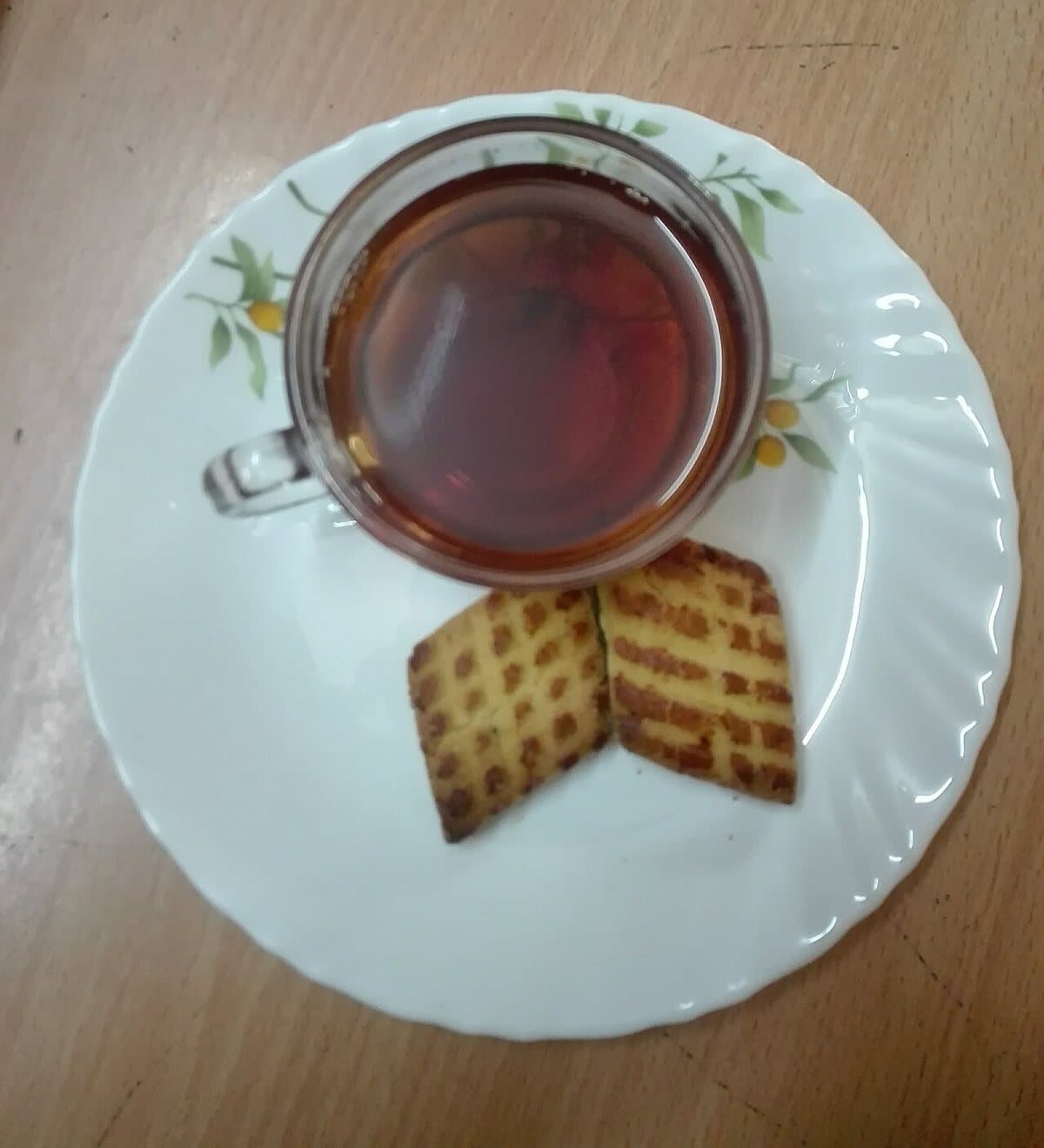
The black tea water ratio that works almost every time is 1 teaspoon of loose leaf (2–3 grams) — or one tea bag — per 8 ounces of water. Strength problems people blame on steep time usually start here: too little leaf makes weak tea no amount of extra minutes can fix (it just gets more bitter), and too much leaf turns even a careful 3-minute steep harsh. This page is the complete scaling math — cups, mugs, teapots, pitchers, gallons, grams — plus the deliberate adjustments for milk tea, strong breakfast brews, and iced tea.
The Ratio Table: Cups to Gallons
Standard strength, using loose-leaf black tea or bags (1 bag ≈ 1 teaspoon ≈ 2–3 g):
| Water | Loose leaf | Grams | Tea bags |
|---|---|---|---|
| 1 cup (8 oz / 240 ml) | 1 tsp | 2–3 g | 1 |
| Large mug (12 oz / 350 ml) | 1½ tsp | 3–4 g | 1–2 |
| Small pot (16 oz / 475 ml) | 2 tsp | 5 g | 2 |
| Full pot (32 oz / 950 ml) | 4 tsp | 9–10 g | 4 |
| Half gallon (64 oz / 1.9 L) | 8 tsp (2¾ Tbsp) | 18–20 g | 8 |
| Gallon (128 oz / 3.8 L) | ⅓ cup | 36–40 g | 16 |
By weight, that's a 1:100 ratio — 1 gram of tea per 100 ml of water — which is the number to remember if you own a kitchen scale, because teaspoons of black tea vary: fluffy large-leaf Assam fills a spoon at barely 2 g while dense broken-leaf blends pack 3.5 g into the same spoon. A scale removes the guesswork; a spoon is fine once you know your tea.
Water matters as much as leaf: black tea wants a full boil (200–212°F) and a 3–5 minute steep. Ratio, temperature, and time are the whole recipe — the tea steeping times chart covers the timing half in detail. The same logic for green, oolong, white and herbal tea is in the site-wide tea to water ratio chart.
Tea & gear for this guide
Hand-matched Amazon picks with strong owner ratings. As an Amazon Associate, Tea & Peace earns from qualifying purchases.
English Breakfast Black Tea
Brisk, malty black tea for hot or iced — 4.8★ across 20,190 ratings.
Shop Now
HOUSE AGAIN Tea Infuser, Extra Fine Mesh Tea Infusers for Loose Tea, 18/8
Fine-mesh stainless infuser for any loose tea — 4.6★ across 26,441 ratings.
Shop Now
Earl Grey Black Tea
Brisk, malty black tea for hot or iced — 4.7★ across 13,032 ratings.
Shop NowProduct prices and availability are accurate as of September 14, 2026 and are subject to change. Any price and availability information displayed on Amazon at the time of purchase will apply.
Adjusting Strength the Right Way
The single most useful brewing rule: change strength with leaf, change bitterness with time.
Want a bolder cup? Go to 1½–2 teaspoons per 8 oz and keep the steep at 3–4 minutes. You'll get more body, more malt, more caffeine — without the mouth-drying astringency that a 7-minute steep produces. Builders' brew and hotel breakfast tea taste harsh precisely because they stretch time instead of adding leaf.
Want it lighter? Use the standard ratio but pull the steep at 2–2½ minutes. Dropping to half a teaspoon of leaf makes tea that's weak and thin; a short steep at full ratio keeps flavor while easing the strength.
For milk tea, brew deliberately strong — 2 teaspoons per 8 oz, 4–5 minutes at a rolling boil — because milk will dilute and soften everything. This is the traditional English breakfast approach, and it's why a standard-ratio cup often tastes like nothing once milk goes in. Our black tea guide covers which varieties stand up to milk best (Assam and Ceylon lead; delicate Darjeeling drowns).
For gongfu-style brewing the math inverts entirely — 5–6 grams in a tiny 120 ml vessel, steeped seconds at a time. See the gongfu tea ceremony guide for that method.
Iced and Cold Brew Black Tea Ratios
Ice and cold dilute flavor, so cold-serving methods start stronger:
| Method | Ratio | Notes |
|---|---|---|
| Hot-brewed iced tea | 2× leaf (2 tsp per 8 oz) | Brew hot + double strength, pour over a full glass of ice |
| Refrigerator cold brew | 1.5× leaf (1½ tsp per 8 oz) | 8–12 hours in the fridge, then strain |
| Sun tea / gallon pitcher | 12–16 bags per gallon | Sweet-tea territory; steep, chill, serve over ice |
Cold brewing is the forgiving route — because refrigerator-temperature water barely extracts tannin, black tea cold brewed at 1.5× strength for 10 hours comes out smooth and dark with none of the bitterness that hot oversteeping risks. The full method is in cold brew black tea, and how to make iced tea covers the fast hot-brew-over-ice version, including how to avoid the cloudy-pitcher problem.
One caution at pitcher scale: resist rounding up "just to be safe." Sixteen bags in a gallon is already robust; twenty makes tannic tea that needs sugar to be drinkable — which is how a lot of oversweetened iced tea gets that way in the first place.
Scaling for a Crowd: The Concentrate Trick
Brewing black tea for twenty people does not require a stockpot of tea. The caterer's method is a concentrate:
- Brew at 4× strength — 1 cup of loose tea (or 16 bags) in a quart of boiling water, steeped 5 minutes and strained.
- Hold the concentrate in a thermos; it keeps its character for a few hours where a diluted urn of tea goes stewed.
- Serve by diluting to taste in the cup: roughly 1 part concentrate to 3 parts hot water, adjusted per drinker.
Every guest effectively gets fresh tea at their preferred strength, and the math stays honest: a quart of 4× concentrate serves about 16 standard cups, so one measuring session covers the table. The same concentrate poured over ice (1:2 with cold water, since ice melts into the balance) is the fastest route to pitcher iced tea that doesn't taste diluted.
One warning: don't hold black tea concentrate more than 3–4 hours or push it past 4× — over-concentrated tannin comes back out of solution as bitterness no dilution fixes.
Why Ratio Beats Steep Time for Fixing Weak Tea
Here's the extraction logic in one paragraph. Black tea's desirable flavors — malt, honey, fruit, brisk edge — extract heavily in the first three minutes. Its bitter tannins keep extracting for as long as leaf touches hot water. So a longer steep changes the ratio of good to harsh in your cup for the worse, while more leaf raises everything proportionally and leaves the balance intact. Weak tea is an amount problem, not a time problem.
The same logic explains the classic teapot mistake: pouring the first cup at minute two and the last cup at minute ten from a pot with leaves loose inside. The final cup is always tannic sludge. Either use an infuser you can lift out at minute four, decant the whole pot at once, or brew with the exact leaf-to-water dose for the volume you'll pour — the table above scales for precisely that reason.
Measured against the loose leaf tea standard 1:100 by weight, bagged tea runs slightly stronger per gram (broken leaf extracts faster), which is why bags are forgiving at one-per-cup but rarely worth doubling. When a recipe needs real strength — masala chai simmered with milk, for instance — loose leaf at 2× ratio wins on flavor; how to make chai tea shows that method end to end.
Ratio Myths Worth Ignoring
"One for each cup and one for the pot." A Victorian rule written for weak Victorian tea and enormous pots. With modern leaf at 1 teaspoon per actual cup of water, the extra 'one for the pot' just makes the last pour harsh. Measure for the water you're using, nothing more.
"Strong tea means long steeping." The most persistent one — covered above, but worth repeating as a myth: time changes the balance of extraction toward tannin; leaf changes the amount. Strong-and-smooth comes only from more leaf.
"Bags are half as strong as loose leaf." Modern bags hold 2–3 grams, the same as a teaspoon; they're not weaker, they're faster. Doubling bags 'to be safe' is how a 12-ounce mug ends up tasting like tannin.
"You can't over-tea, only over-steep." Past roughly double the standard ratio, black tea extracts so much tannin per minute that even a 2-minute steep turns drying. The milk-tea zone (2 tsp per cup) is the practical ceiling for drinking straight.
The honest summary of the whole page: weigh once to calibrate your spoon, use the table for the vessel in front of you, and spend your attention on water temperature and steep timing — the two variables that reward it.
From our testing notes
We weighed ten 'teaspoons' of three different black teas on a 0.1 g scale: a whole-leaf Assam averaged 2.1 g per spoon, an English breakfast blend 2.9 g, and a fine-cut Ceylon 3.4 g — a 60% swing from the same measuring spoon. Brewed at one spoon per cup, the Ceylon consistently tasted 'stronger' for no reason other than density. Switching to 2.5 g by weight made all three brew to comparable strength.
Sources & further reading
Frequently asked questions
How much black tea for one cup of water?
One teaspoon of loose leaf (2–3 grams) or one tea bag per 8-ounce cup, steeped 3–5 minutes in water just off the boil. For a large 12-ounce mug, use a heaped teaspoon or add a second bag.
What is the black tea ratio by weight in grams?
1 gram per 100 ml of water — so 2.4 g for an 8 oz cup, 5 g for a 16 oz pot, 10 g for a quart. Weighing beats spooning because leaf density varies widely between black teas.
How many tea bags do I need for a gallon of black tea?
16 bags for standard strength, 12 for lighter tea. If you're serving it iced, brew with 16 in half the water, then top up with cold water and ice — you get full flavor without oversteeping.
Does more tea mean more caffeine?
Yes, almost linearly — caffeine scales with the amount of leaf more than with steep time. A double-leaf cup carries roughly double the caffeine, which is worth knowing for evening tea. Cold brewing extracts somewhat less; see our cold brew caffeine guide for numbers.
Why does my black tea taste bitter even when I measure correctly?
Almost always time or temperature: a steep past 5 minutes, or leaves left sitting in the pot while you drink. Decant fully at 4 minutes, or lift the infuser out. Very hard tap water also accentuates harshness — try filtered water once as a test.
Can I reuse black tea leaves for a second cup?
Good loose-leaf black tea gives a solid second steep — add a minute to the time. Tea bags mostly don't; broken leaf spends itself in one brew. If a second cup matters to you, it's one of the practical arguments for loose leaf.
Is a heaping teaspoon or level teaspoon correct?
Level, for dense broken-leaf tea; gently heaped, for large fluffy whole leaves. If that feels ambiguous, that's the case for the scale: 2.5 grams is 2.5 grams regardless of how the leaf sits in the spoon.
What ratio do hotels and restaurants use for black tea?
Typically one bag per small pot (about 12 oz) — slightly under-leafed, which is why restaurant tea often tastes thin. Asking for two bags, or an extra pot of hot water with a properly steeped first pot, fixes it.
Does the ratio change for English breakfast vs Earl Grey vs plain black tea?
No — all are black teas and take the same 1 tsp per cup baseline. Flavored teas like Earl Grey sometimes read stronger because of the bergamot oil, so some drinkers steep them 30 seconds shorter, but the leaf-to-water dose stays the same.
How much loose black tea for a standard 6-cup teapot?
A 6-cup pot holds about 32 oz brewed: use 4 teaspoons (9–10 g). Decant or remove the leaves once steeped so the last cup poured isn't bitter — the ratio only holds if steeping actually stops.