
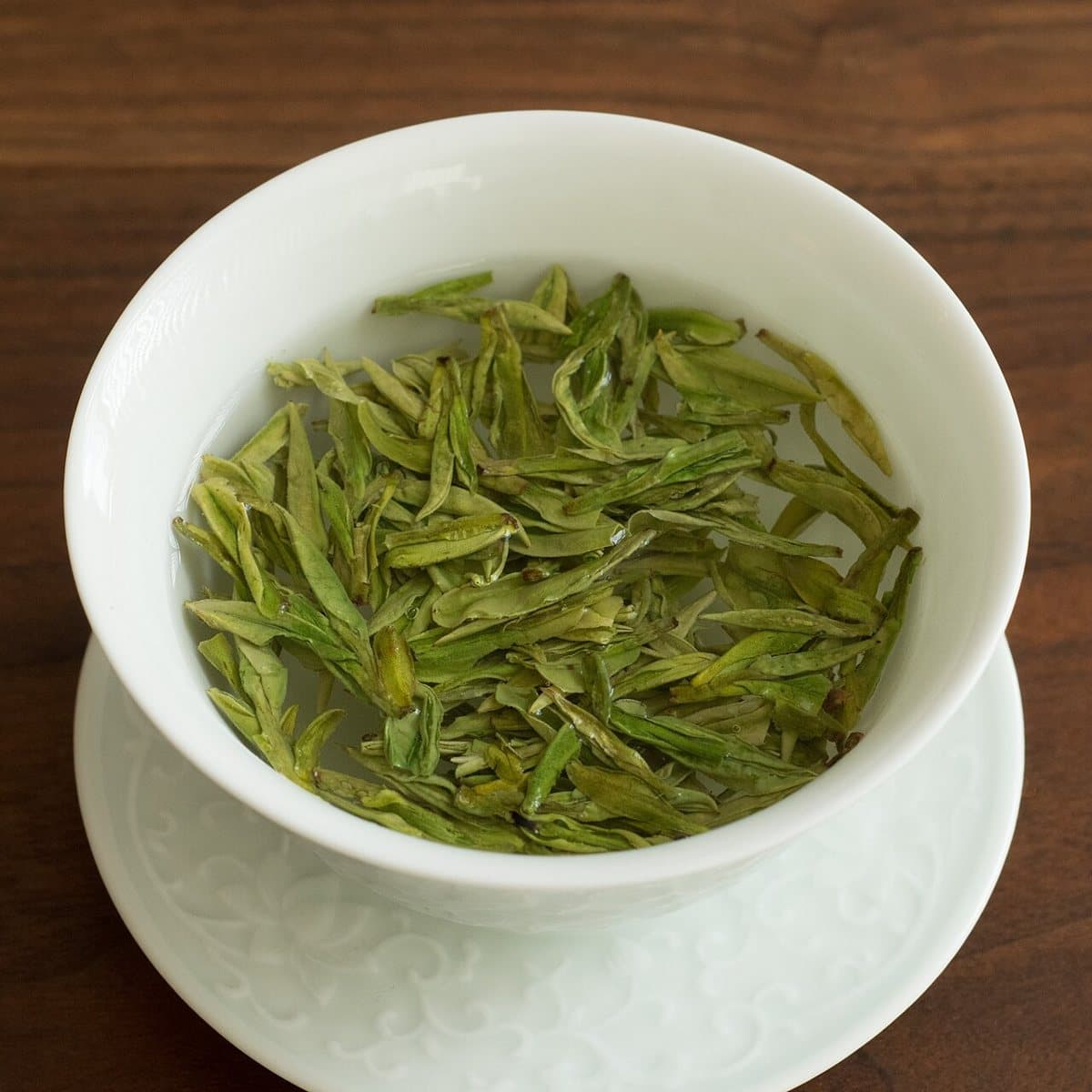
Tea steeping times make or break a cup: the exact same leaves can taste sweet and layered at 2 minutes or harsh and drying at 6. Most brewing frustration — bitterness, flatness, "this tea tastes like nothing" — traces back to time and temperature, not the tea itself. This chart covers every major type of tea we brew, hot and cold, with the timing windows that consistently produce a clean cup, why the windows differ so much between types, and how to rescue a steep that's gone wrong.
Quick answer
- ✓Green tea: 1–3 minutes at 160–180°F. Black tea: 3–5 minutes at 200–212°F. Oolong: 2–5 minutes at 185–205°F.
- ✓Herbal tisanes are nearly oversteep-proof — 5–15 minutes at a full boil is normal.
- ✓Time and temperature trade off: cooler water forgives longer steeps; boiling water punishes them.
- ✓Cold brewing stretches every window to hours (6–12) and strips out most bitterness.
- ✓Quality loose leaf resteeps 2–4 times — add 30–60 seconds each round.
The Master Steeping Chart
Bookmark this one table. Times assume Western-style brewing — a teaspoon or two of loose leaf per 8-ounce cup. (Gongfu brewing uses far more leaf and much shorter steeps; more on that below.)
| Tea type | Water temp | First steep | Resteeps | Oversteep risk |
|---|---|---|---|---|
| White tea | 170–185°F | 3–5 min | 2–3, +1 min each | Low |
| Green tea (Japanese) | 160–170°F | 1–2 min | 2, +30 sec | High |
| Green tea (Chinese) | 175–185°F | 2–3 min | 2–3, +30 sec | Medium |
| Oolong (light/floral) | 185–195°F | 2–3 min | 3–4, +30 sec | Medium |
| Oolong (dark/roasted) | 195–205°F | 3–5 min | 3–4, +1 min | Low |
| Black tea | 200–212°F | 3–5 min | 1–2, +1 min | High |
| Pu-erh (ripe/shou) | 205–212°F | 3–4 min | 4+, +30 sec | Low |
| Matcha | 165–175°F | Whisked, not steeped | — | — |
| Herbal / tisane | 212°F | 5–15 min | 1, same time | Very low |
| Rooibos | 212°F | 5–7 min | 1 | Very low |
Two patterns worth noticing. First, the more delicate and less oxidized the leaf, the cooler and shorter the brew — Japanese greens sit at one extreme, herbal tisanes at the other. Second, oversteep risk tracks tannin content: black and green teas turn bitter fast, while herbal blends and ripe pu-erh barely change after minute five. Time is half the equation; the tea water temperature chart is the other half, and how many times can you steep tea covers what happens after the first steep.
Tea & gear for this guide
Hand-matched Amazon picks with strong owner ratings. As an Amazon Associate, Tea & Peace earns from qualifying purchases.
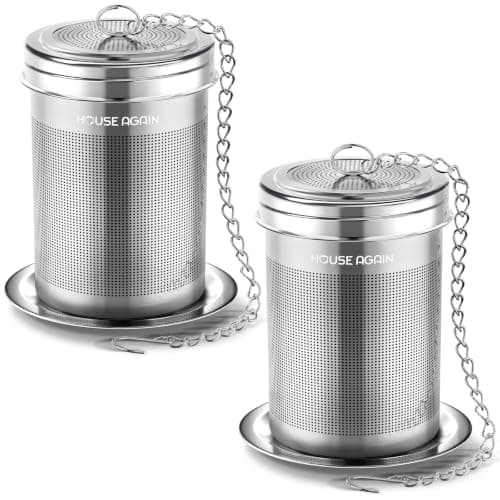
HOUSE AGAIN Tea Infuser, Extra Fine Mesh Tea Infusers for Loose Tea, 18/8
Fine-mesh stainless infuser for any loose tea — 4.6★ across 26,441 ratings.
Shop Now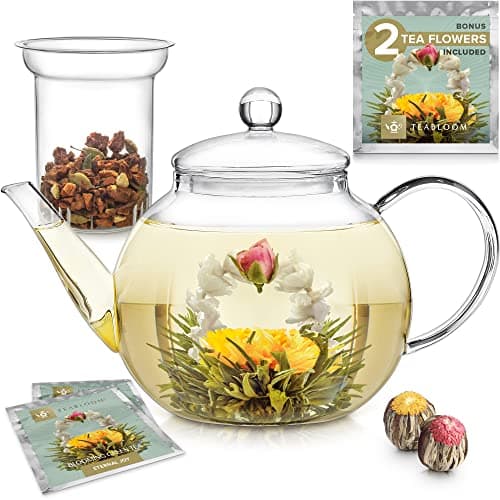
Teabloom Stovetop & Microwave Safe Glass Teapot with Removable Loose Tea
Borosilicate glass teapot with a removable infuser — 4.6★ across 26,185 ratings.
Shop Now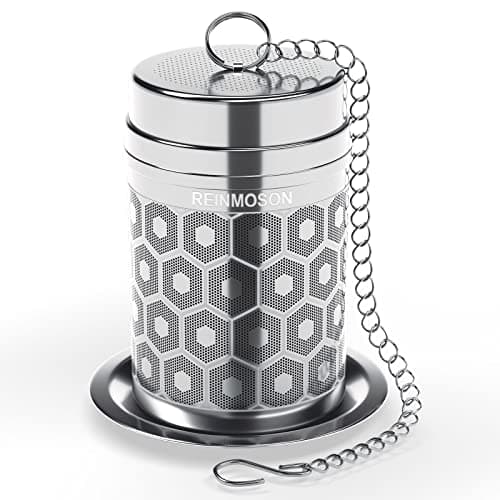
Reinmoson Tea Strainers for Loose Tea, Extra Fine Mesh Tea Infuser, 304
Fine-mesh stainless infuser for any loose tea — 4.7★ across 12,790 ratings.
Shop NowProduct prices and availability are accurate as of September 15, 2026 and are subject to change. Any price and availability information displayed on Amazon at the time of purchase will apply.
Why Steeping Time Changes So Much Between Teas
Steeping is extraction, and different compounds leave the leaf at different speeds. Aromatic oils and amino acids (the sweet, savory notes) come out early. Caffeine follows through the early-middle of the steep — our cold brew tea caffeine guide covers how timing shifts it. Tannins — the astringent, mouth-drying polyphenols — extract slowest but keep coming as long as the leaf sits in hot water.
That sequencing is the entire logic of the chart. A 2-minute green tea steep captures sweetness and stops before tannins dominate. A 4-minute black tea steep deliberately pulls more tannin, because black tea's malty character needs that structure — especially if you're adding milk. Herbal tisanes contain no tea-plant tannins at all, which is why a forgotten cup of chamomile at minute twelve still tastes fine.
Temperature is the throttle on all of it. Boiling water extracts everything faster, tannins included. Drop the temperature 20 degrees and the same steep time yields a noticeably softer cup. This is why the two variables always move together: hotter water, shorter time; cooler water, longer time. Cold brewing is the extreme case — at refrigerator temperature, tannins barely extract at all, which is why cold brew tea steeps for 8 hours yet tastes smoother than a 5-minute hot brew.
Western Steeping vs Gongfu Steeping
Everything above describes Western brewing: a small amount of leaf, a big mug, one long steep. Chinese gongfu brewing inverts the formula — a lot of leaf in a small vessel, steeped many times for seconds rather than minutes.
A gongfu session with oolong might run: rinse (5 seconds, discarded), then steeps of 10, 15, 20, 30, 45 seconds, and onward — ten or more infusions, each with a slightly different character. The first steeps are bright and aromatic, the middle steeps fullest, the late steeps soft and sweet. If that appeals to you, our gongfu tea ceremony guide walks the full method and the minimal gear it needs — a gaiwan and a strainer will do.
Neither approach is "correct." Western brewing is convenient and consistent; gongfu shows you what a good leaf can actually do. The chart's resteep column is the bridge: any tea that resteeps well Western-style will reward gongfu brewing.
How Leaf Size and Shape Change the Clock
The chart assumes typical leaf for each type, but the same tea in a different physical form steeps on a different clock:
- Broken leaf and bags extract 30–60 seconds faster than whole leaf — more cut surface, faster release. This is why the same 4-minute habit that suits a whole-leaf black tea oversteeps its bagged version.
- Tightly rolled teas (gunpowder green, ball-rolled oolongs) run the other way: the first minute is spent just unfurling. Give them a hot 5-second rinse first, or accept that steep one is really steep zero-point-five.
- Compressed teas (pu-erh cakes, shou mei bricks) need physical breaking plus a rinse before the chart applies; the first proper steep after that behaves normally.
- Powdered tea (matcha) has no steep time at all — it's whisked into suspension and consumed whole, which is why it appears in the chart with a dash.
A practical rule that covers all of it: the finer or more broken the tea, the shorter and cooler; the denser or more compressed, the more it benefits from a rinse and a patient first infusion. When you switch a familiar tea between loose and bagged form, re-time it once instead of trusting the old habit — the black tea water ratio guide shows the same logic applied to dose.
What Oversteeping Actually Does (and How to Rescue It)
Oversteeped tea isn't ruined tea — it's over-extracted tea, and there are three honest rescues:
- Dilute it. Add hot water until the astringency drops back into balance. A cup steeped double its time roughly wants double its water.
- Chill it. Bitterness reads weaker cold. An oversteeped black tea over ice with a squeeze of lemon becomes perfectly good iced tea.
- Add milk. Milk proteins bind tannins directly — it's why strong breakfast blends and milk are a classic pairing rather than a coincidence.
What you can't rescue is aroma: the delicate top notes of a green or floral oolong boil away and don't come back. With those teas, set a timer. Two minutes of attention beats any rescue.
Understeeping has a simpler fix — put the leaves back in. Nothing is lost by pulling a steep early and returning it to the water for another minute.
Steeping Times for Cold Brew
Cold brewing replaces minutes with hours and removes most of the ways to get it wrong. The windows are wide:
| Tea | Cold steep time |
|---|---|
| Green tea | 6–8 hours |
| White tea | 6–8 hours |
| Oolong | 8–10 hours |
| Black tea | 8–12 hours |
| Herbal | 10–12 hours |
An hour long or short changes very little — refrigerator-temperature extraction is slow enough to be forgiving. Use roughly 1.5× your normal amount of leaf, steep in the fridge, and strain. The cold brew tea steep time guide breaks down each type in more detail, and how to make cold brew tea covers the full method if you're starting from zero.
One timing rule does matter in the cold: don't go far past 24 hours. Past that point the brew slowly picks up stewed, woody notes, and food-safety guidance for any refrigerated infusion applies.
Water Quality: The Invisible Variable
Two cups steeped for identical times can taste a class apart because of the water. Hard, mineral-heavy tap water blunts aroma and exaggerates astringency — its dissolved minerals compete with extraction and react with tea polyphenols (the same reaction that forms the film on a mug of hard-water black tea). Very soft or distilled water swings the other way, making thin, flat tea with nothing for flavor to push against.
The practical target is lightly mineralized, fresh, and oxygenated: an ordinary carbon filter (pitcher or tap) lands most municipal water in the right zone, and freshly drawn water beats water re-boiled three times, which has lost dissolved oxygen and brews noticeably duller. If your kettle wears white scale, your tea is telling you the same thing the kettle is — and a descaling session plus filtered water is the cheapest flavor upgrade in this entire guide.
Temperature control closes the loop: without a variable-temperature kettle, the workable shortcut is resting boiled water — roughly 2 minutes off the boil ≈ 190°F, 4–5 minutes ≈ 175°F in a typical kettle. Good enough for every window in the chart.
From our testing notes
We ran the same Chinese green tea (a Dragonwell) through steeps at 1, 2, 3, and 5 minutes at 175°F, tasting blind. The 2-minute cup won clearly — the 1-minute steep was thin, 3 minutes was still good but drier, and 5 minutes was noticeably astringent at the back of the tongue. The gap between 2 and 5 minutes was bigger than the gap between the $12 tea and a $30 tea brewed correctly.
Sources & further reading
Frequently asked questions
How long should I steep tea if I don't know what type it is?
Use 3 minutes at 185°F as a safe middle. It slightly understeeps black tea and slightly oversteeps delicate Japanese green, but produces a drinkable cup of almost anything. Taste, then adjust one minute at a time on the next brew.
Does steeping tea longer make it stronger or just more bitter?
Both, in sequence. Extra time first deepens body and caffeine, then keeps pulling tannins after the desirable compounds are mostly out. For a genuinely stronger cup, use more leaf rather than more time — strength scales with leaf quantity without the added astringency.
Can you steep tea too long for it to be safe?
Hot tea left steeping for an hour is unpleasant, not unsafe. The safety consideration is standing time at room temperature: like any brewed beverage, tea left out for more than about 8 hours is better discarded, and refrigerated tea is best within 3–4 days.
Why does my green tea turn bitter even at 2 minutes?
Almost always water temperature, not time. Water straight off the boil scorches green tea regardless of a short steep. Let the kettle rest 3–4 minutes after boiling (or pour at 170°F on a variable kettle) and the same 2-minute steep comes out sweet.
How many times can I resteep the same leaves?
Bagged tea: once, maybe twice. Quality loose leaf: 2–4 times Western-style, adding 30–60 seconds per round. Oolong and pu-erh are the champions — brewed gongfu style they can run past ten infusions before fading.
Do tea bags steep faster than loose leaf?
Slightly, because the leaf inside is broken into smaller particles with more surface area. That's also why bags turn bitter faster. Shave 30–60 seconds off the chart times when brewing bags, especially for black tea.
Do steeping times change for iced tea?
For hot-brewed iced tea, steep normal times but at double strength, then pour over ice — extending the time instead adds bitterness that cold accentuates. For refrigerator cold brew, times shift to hours: 6–8 for green, 8–12 for black, with almost no oversteep risk.